
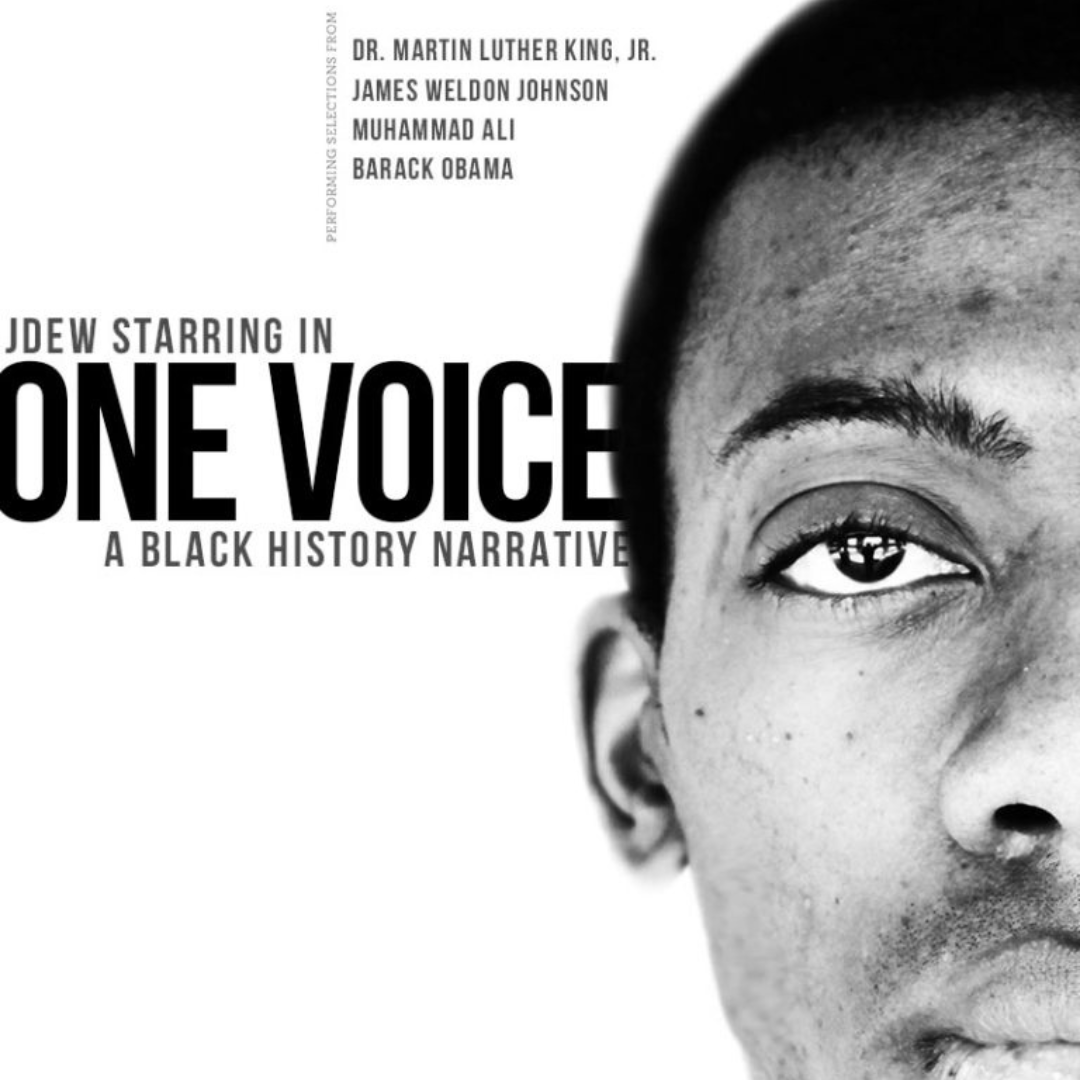
A Black History Narrative

“One Voice” Brings Black American History to Life

Dew Productions's “One Voice” is an exceptional narrative highlighting orations from some of America’s most influential black leaders.  “One Voice” is a fascinating journey through the black American experience, by virtue of eight powerful and influential voices spanning from the 1820s to present day including: Martin Luther King, Jr., Muhammad Ali, Bill Cosby, and Barack Obama.

This one-man performance is divided into eight chapters and covers a variety of genres including: poetry, essay, political activism, standup comedy, campaign speech, and more. Interspersed within the show are powerful video pieces including interviews with prominent African Americans in the Upstate of South Carolina who share their personal stories.


The Figures

Martin Luther King, Jr.

Jan. 15, 1929 - April 4, 1968. Martin Luther King, Jr. changed the course of history for African-Americans with his political activism for desegregation and voting and labor rights. He helped found the Southern Christian Leadership Conference (SCLC) in 1957, and was the first president of the organization until his death. King, Jr., representing the SCLC, along with five other civil rights organizations, planned and successfully carried out the March on Washington for Jobs and Freedom on August 28, 1963. One of the most famous speeches in history, “I Have a Dream”, was given by Martin Luther King, Jr. on the steps of the Washington Memorial that day. The The Civil Rights Act of 1964 and the Voting Rights Act of 1965 became law as a result of King Jr.’s work. In 1964, King, Jr. became the youngest person in history to be awarded the Nobel Peace Prize. A memorial in honor of the man and his work was opened in the National Mall in Washington, D.C. on October 16, 2011.

Muhammad Ali

Jan. 17, 1942 - present. In 1964, Cassius Marcellus Clay, Jr. changed his name to Muhammad Ali after joining the Nation of Islam. Muhammad Ali is considered to be the greatest boxer of all time. His gold medal win in the 1960 Summer Olympics in Rome triggered his professional boxing career, and he won his first Heavyweight Champion title against Sonny Liston in 1964. But when Ali evaded military drafting in 1967 for the Vietnam War he was stripped of his first title and his boxing license was suspended. Ali declared that war went against Muslim teaching and considered himself a conscientious objector. When he was allowed to return to the ring, he went on to earn two more Heavyweight Champion titles, the second against George Foreman in 1974, and the third against Joe Frazier in 1975. Ali has been named the “Sports Personality of the Century” for his flamboyance and cheeky poems about his opponents. In recent years, Ali has been awarded the Presidential Citizens Medal and the Presidential Medal of Freedom for his work in the civil rights movement.

James Weldon Johnson

June 17, 1871 - June 26, 1938. James Weldon Johnson is best known for being influential in his writings: novels, poetry, collections of folklore, songwriting, as well as his leadership within the NAACP. He graduated from Atlanta University in 1894, and became an educator and principal of the African American school, Stanton, Jacksonville’s largest public school. He was also the first African American admitted to Florida’s Bar Exam since Reconstruction. In 1900, after Johnson penned the words to “Lift Every Voice and Sing”, his brother set the poem to music: now known as “The African American National Anthem.” Rev. James Lowery used the third stanza of the song in the beginning of his benediction for President Barack Obama’s inauguration ceremony. Johnson’s most famous work published in 1927, God’s Trombones: Seven Negro Sermons in Verse, is a book of seven sermon poems inspired by a folk preachers he had heard speak from boyhood to his adult life. His instrument of choice, the trombone, was selected because it most resembles the range and sound of the human voice.

Frederick Douglass

c. Feb. 1818 - Feb. 20, 1895. Frederick Douglass was an American social reformer, writer, orator, and statesman. After escaping slavery, he became a leader of the abolitionist movement, gaining note for his dazzling oratory and incisive antislavery writing. He stood as a living counter-example to slaveholders’ arguments that slaves did not have the intellectual capacity to function as independent American citizens. Many Northerners also found it hard to believe that such a great orator could have been a slave. He eloquently described his experiences in slavery in his 1845 autobiography, Narrative of the Life of Frederick Douglass, an American Slave, and the book became influential in supporting abolition. Douglass wrote two more autobiographies, with his last, Life and Times of Frederick Douglass, published in 1881, covering events through and after the Civil Wars. During the Civil War he became a consultant to Abraham Lincoln, and was later appointed as the U.S. minister and consul general to Haiti from 1889 to 1891.

Barack Obama

The 44th and current President of the United States, Barack Hussein Obama II,  is also the first African American to hold the office. He graduated from Columbia University and Harvard Law School, working as a community organizer in Chicago before finishing his law degree. He worked as a civil rights attorney in Chicago and taught at the University of Chicago Law while representing the 13th district of Illinois as a State Senator for three consecutive terms. In 2004, he won a U.S. Senate seat and gained attention for his speeches in the campaign leading up to his victory. He beat Hillary Clinton in a close battle for the 2008 Democratic Party presidential primary, and went on to defeat the Republican nominee, John McCain in the presidential election in November. In 2009, he was awarded the Nobel Peace Prize for his “extraordinary efforts to strengthen international diplomacy and cooperation between peoples.”

Bill Cosby

Dr. William Henry “Bill” Cosby, Jr. has been in comedy for over 50 years. He became immensely popular in the ‘80s for his stand up comedy and his sitcom show portrayal of the African American family. His television debut came in the 1960s on the show, I Spy, a secret-agent action adventure series. From 1984-1922 he starred in The Cosby Show, a humorous, family-oriented alternative to the progressively vulgar material being displayed on other TV shows. As America watched and fell in love with the affluent African American family, the show grew in ratings and quickly became the highest ranking sitcom of all time. Some of his other famous works include the TV show Kids Say the Darndest Things and the 2004 movie Fat Albert. In 2002, he was awarded the Presidential Medal of Freedom for his unforgettable work in television.